

Among my hobbies and love, time is dedicated for LEGO bricks, a game created for children and over the years it has been able to keep up-to-date. From my point of view, the greatest success of LEGO has been to broad its target market to adults, proposing sets of bricks ranging from transport devices to urban buildings, to movie sets of Star Wars and Harry Potter, real masterpieces to be proudly displayed in our living rooms. Social networks did their part, virtual communities called AFOL (Adult Fans of LEGO) exchange ideas and personal projects. Try to search on Google Images for the keywords “Lego Space Shuttle MOC” to realize the mastery of some AFOLs! But a world created in miniature starts from a simple idea: LEGO implements one of the most important fundamentals of engineering, modularity, so each brick has a specific shape and is able to mate with all the others, without apparent limits.

After this introduction, you should not be surprising that the modularity has been applied in personal finance too. Fundamental financial tools such as stocks and bonds are our building blocks, which are “joined” together to build indices, hereafter indices are put togheter into sub-portfolios and then into global ones. That’s sound easy … but it’s not! If we take a box full of bricks and we want to build, for instance, our little Eiffel Tower, certainly we are not able to figure out how to start! Here comes the essential booklet with the “building instructions”, that leads us step by step to assembly our set. Well, at the same way, it is not enough to have a list of stocks and bonds to build our portfolio but also we must have instructions for aware investors.
Core – Satellite method
A solution that has been very successful in last years is the so called “Core – Satellite”. In full compliance with the modular method, the bricks of our portfolio are initially splitted into two parts:
- a main section, called Core, collects stocks that concurs with the market. Large-cap companies, ETFs tracking the main world indices, bonds of large firms, all of them usually fall within Core. Core’s main target is to obtain a return in line with market performance, therefore the most used strategy is the static one, taking rebalance few times per year and operating on long-term time intervals to capture the main price movement of of the market.
- a secondary section, called Satellite, contains all the specialized stocks. Sector ETFs, emerging markets, high yield bonds, commodities, active funds: these are just some examples of tools that have one or more features that apart them from the market. Satellite’s main target is to overperform the market, dealing a greater risk in order to achieve an extra return. Dynamic strategies are the most suitable for this purpose, working on higher frequencies than those used in Core section.
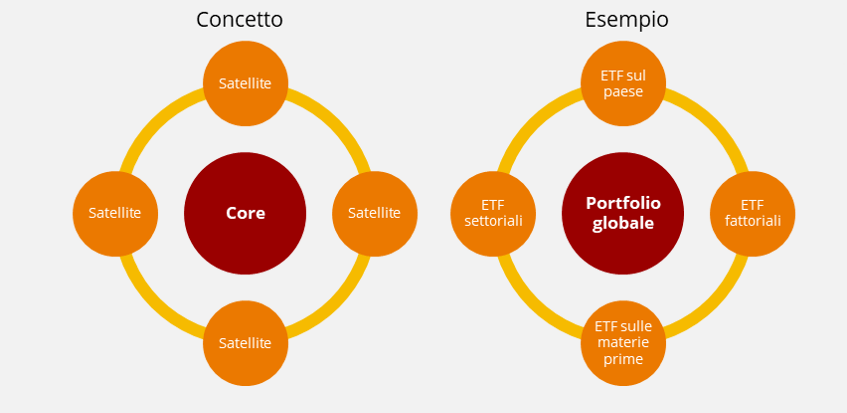
For proper portfolio risk management, Core takes a larger size than Satellite, and proportion moves towards around 70-30%.
The Core – Satellite method has the great credit to provide the guidelines we need to write the “building instructions” for a portfolio that leads to our investment targets, achieving good diversification on three levels – market, strategy and timeframe. Let’s now dive into practice what we have seen so far, assembling two portfolios.
Target Return and Target Income
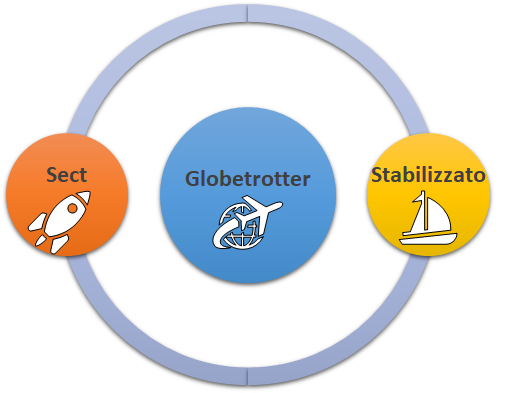
In the last months, in this blog I showed three portfolios – each of them has its own soul and they are able to meet single investment needs. Quickly summarizing, we have:
- Globetrotter, a static strategy portfolio that aims to replicate world markets;
- Sect, searching for maximum return by implementing a rotational strategy on a basket of world sector ETFs;
- Stabilized, to obtain an income from High Yield bonds, with accurate risk management.
It is not difficult to apply the Core – Satellite method on these three portfolios: if Globetrotter has the right stuff to be part of Core, Sect and Stabilized have the right value of specialization required by Satellite.
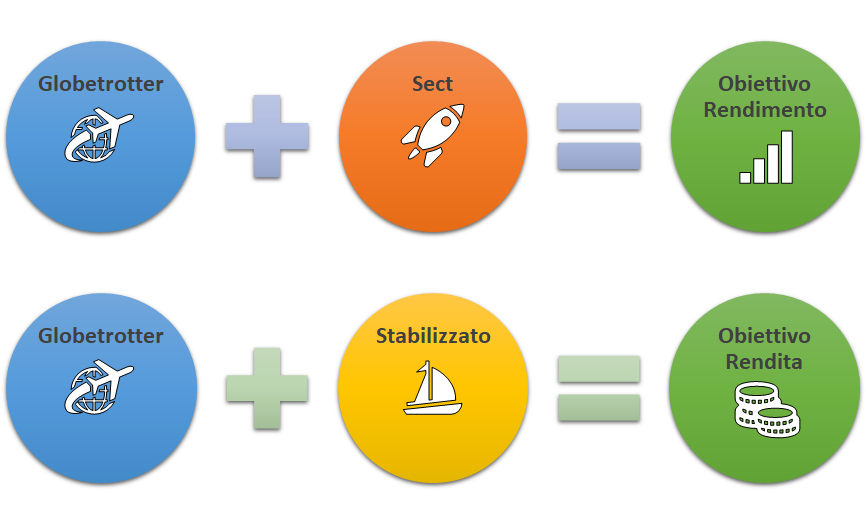
In figure 2, we see what we get if we combine them: in the first line, Globetrotter plays the part of Core while Sect of Satellite, making a portfolio that we will call “Target Return“; in the second line, Stabilized is merged with Globetrotter to create “Target Income” portfolio. The behaviour of these two portfolios are inherited from their respective satellites, “Target Return” moves towards maximizing returns while “Target Income” aims at coupon flows. These two new portfolios can fulfil two of the most recurring investor targets – to get return and income.
TARGET RETURN
The percentages chosen for this portfolio is 70% for Globetrotter and 30% for Sect. This ratio agrees with the rule to provide more space to the Core section. If we drill down to the level of ETFs, we find that the portfolio consists of four stocks, as listed in the table below.
| Index | ETF | Weight (%) |
|---|---|---|
| Global Aggregate Bond | AGGH.MI | 53 |
| MSCI ACWI | ACWIA.MI | 10 |
| Physical Gold | SGLD.MI | 7 |
| (Sectors Rotation) | – | 30 |
Remind that Globetrotter iconsists of 3 ETFs / ETCs – a global bonds fund (AGGH.MI), a global stocks fund (ACWIA.MI) and a physical gold fund (SGLD.MI), with a ratio that currently is respectively 75 – 15 – 10%. Then, these weights are multiplied by 70% to find the final weights displayed in the table. The sector ETF is define each month based on the rotational strategy used by Sect.
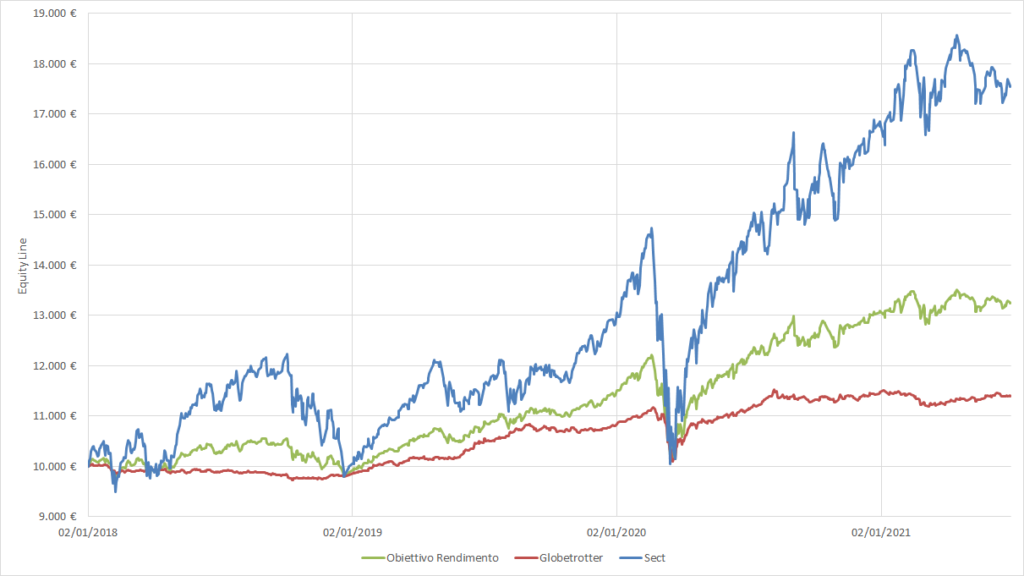
All the ETFs are total return, in order to increase the invested equity. Figure 3 shows a simulation of the last four years, where the green Equity Line is “Target Return”, related to Globetrotter (red) and Sect (blue). The return and the risk have an average annual values of about 8% and 10% respectively, values that lead to a Investment Time Horizon of more or less 4 years.
TARGET INCOME
For those are looking for an income that is able to not affect the equity, “Target Income” may be the answer. In the following table we can see the structure of the portfolio, where Stabilized brings four ETFs, all bonds and with a weight of 80% for the two High Yields and 20% for Government Bonds.
| Index | ETF | Weight (%) |
|---|---|---|
| Global Aggregate Bond | AGGH.MI | 45 |
| MSCI ACWI | ACWIA.MI | 9 |
| Physical Gold | SGLD.MI | 6 |
| € High Yield Corporate Bond | IHYG.MI | 16 |
| $ High Yield Corporate Bond | IHYU.MI | 16 |
| € Gov. Long Term | EM15.MI | 4 |
| $ Gov. Medium Term | US7.MI | 4 |
Ratio between Globetrotter and Stabilized is respectively 60 – 40%, it is more skewed towards the Satellite side than to “Target Return”, since Stabilized has less volatility than Sect and therefore it can have a greater weight, for the benefit of the income flow which depends exclusively from the two High Yield ETFs.
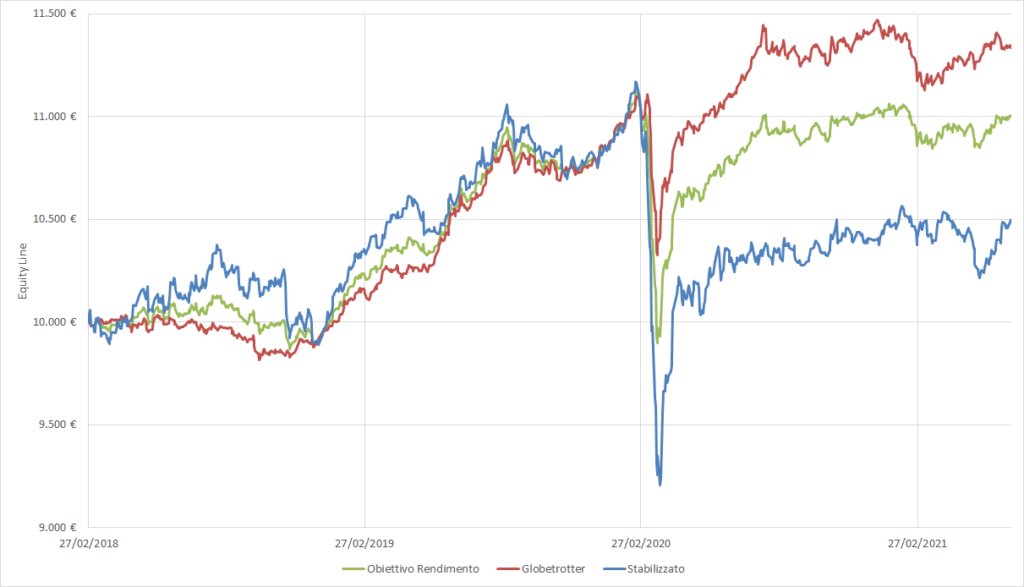
The Equity Line of “Target Income” is the green one in figure 4. The risk is 4% per year, meanwhile the yearly return is 3% and the Investment Time Horizon is roughly 4 years. We cannot forget that the two High Yield ETFs contribute with a income flows of an average value of 1.5% on the invested equity, leading the portfolio total return to 4.5%.
Conclusion
In a LEGO set, probably what really has value is the booklet with building instructions, inside there is the magic that allows us to begin from a bunch of bricks and to get a little piece of art. The Core – Satellite approach helps who want to write the instructions for own portfolio, and the two portfolios seen before give a good example.
“Target Return” and “Target Income” are complementary and they could exist together inside an investor’s portfolio. For everyone that wants to build an additional income for the retirement period, a good example is to create a kind of relay race: in the early years, investor starts with “Target Return”, focus on equity growth, then the Satellite Sect reduces its size to advantage of Stabilized, converting the portfolio to “Target Income.”
If you have any questions to ask me, do not hesitate to write to me in the form below, otherwise you can find me on Facebook and LinkedIn. If you want to stay up-to-date and not miss any article as soon as it comes out, subscribe to the newsletter by filling out the following form:
If you like my articles and MP Investit project, you can support me with a free donation with PayPal or with a Brave browser reward. This encourage me to produce better and better content. Thank you!